

A 409A valuation is an independent appraisal of the fair market value (FMV) of a private company’s common stock, required under U.S. Internal Revenue Code Section 409A before a startup can grant stock options at a defensible strike price. A qualifying appraisal holds for 12 months, or until the next material event, whichever comes first.
This guide covers when a startup needs a 409A, what it costs by stage, how the valuation is calculated, how the resulting common-stock FMV differs from the price of a fundraising round, and the safe-harbor rules that keep option grants defensible.
The short version:
- What it is: an independent appraisal of a company’s common-stock FMV under IRS §409A.
- When it is required: before the first option grant, at least every 12 months, and after any material event (a priced round, large secondary, or acquisition talks).
- What it costs: roughly $1,000-$2,500 pre-seed, rising to $8,000-$25,000+ pre-IPO.
- How long it is valid: 12 months, or until the next material event.
- Who provides it: a qualified independent appraiser, usually bundled through a cap-table platform early on and a specialist firm later.
When you need a 409A
A fresh 409A is required in any of these situations:
- Before the first stock option grant. A company should not grant options until a valuation is in place.
- At least once every 12 months, even if nothing material has changed.
- After a “material event”: a priced equity round, a significant secondary, an acquisition offer, a major pivot, or a financial milestone (a large customer, regulatory clearance, a layoff). Any event that meaningfully changes the company’s value.
- Before granting options on a stale valuation. If the most recent 409A is older than 12 months or pre-dates a material event, the IRS will not treat it as safe harbor, and the strike price is open to challenge.
The safe-harbor clock is not strictly 12 months; the governing rule is “no material event since.” In practice, most startups refresh annually, with an additional refresh after each priced round.
What a 409A valuation costs
US market prices for an independent 409A in 2025-2026, by company stage:
| Stage | Typical price (one-time) | Provider type |
|---|---|---|
| Pre-seed / pre-revenue | $1,000-$2,500 | Bundled via cap-table platform (Carta, Pulley, AngelList, etc.) |
| Seed → Series A | $2,000-$4,000 | Bundled, or a specialist appraiser |
| Series B-C | $4,000-$8,000 | Specialist independent appraiser |
| Series D+ / pre-IPO | $8,000-$25,000+ | Big-four or specialist appraiser; more methodology required |
Price is driven by stage, complexity, methodology, and turnaround. A pre-revenue company valued mostly from comparables sits at the low end; a late-stage company that requires multiple scenario models and a hybrid allocation sits at the high end, and an expedited timeline adds cost. Most early-stage companies obtain the 409A as part of an equity management platform bundle, which is inexpensive because the platform already holds the cap table and runs a templated process. Past Series B, a standalone independent appraiser is more common: the methodology becomes more involved and IRS scrutiny rises, shifting the trade-off from “cheap and bundled” toward “defensible and specialist.”
How a 409A is calculated
A 409A is a two-step exercise: value the whole company, then allocate that value down to the common stock employees receive.
The three valuation approaches
An appraiser draws on three standard approaches, typically weighting two or three of them:
- Market approach: benchmarks the company against comparable public companies and recent M&A or financing transactions, using revenue or EBITDA multiples. It is the most common driver for venture-backed companies.
- Income approach: discounts projected future cash flows to present value (a DCF). It is useful once revenue and forecasts are reliable, and weak for pre-revenue startups.
- Asset approach: values the company’s net assets, or the cost to recreate the business. It is most relevant for very early or asset-heavy companies with limited going-concern value.
Allocating value to common stock
Once an enterprise value is established, the appraiser allocates it across share classes, because preferred and common shares are not worth the same amount per share. The standard methods are the Option Pricing Model (OPM), which treats common stock as a call option on enterprise value above the preferred liquidation stack; the Probability-Weighted Expected Return Method (PWERM), which models discrete exit scenarios (IPO, acquisition, dissolution) and weights them by likelihood; the Current Value Method (CVM); or a hybrid of OPM and PWERM. A discount for lack of marketability (DLOM) is then applied, because private shares cannot be sold freely.
The result is that common-stock FMV almost always lands below the most recent preferred-round price. The next section explains why.
409A FMV vs. your fundraising round
A 409A valuation typically comes back lower than the price investors paid in the most recent round. This is expected rather than an error: the two figures price different securities.
A fundraising round prices preferred stock, which carries a liquidation preference and often anti-dilution, dividend, and control rights. A 409A prices common stock, which has none of those rights, and then discounts it further for illiquidity through the DLOM. Two different securities produce two different per-share prices.
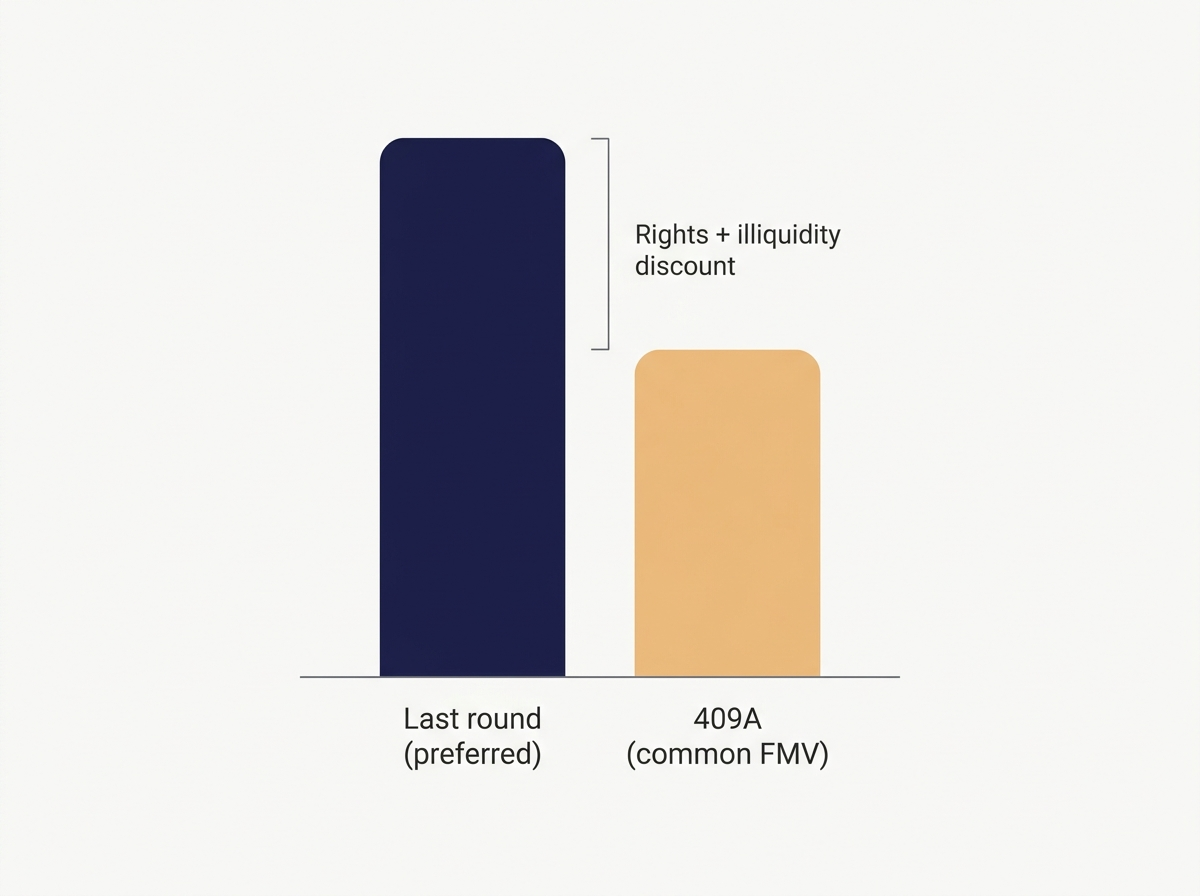
A worked example illustrates the gap. If Series A investors buy preferred at $2.50 per share and the appraiser values common at $1.50 per share (a 40.0% discount to the round price), employee options are struck at $1.50, not $2.50. The difference reflects the value of the preferred’s downside protection plus the illiquidity discount, not a discrepancy in either figure.
Common-stock FMV commonly runs 20%-40% below the preferred price at seed and Series A, sometimes more, and the gap narrows as the company matures and an IPO (where common and preferred converge) becomes more likely. Stripe’s 2023 down-round (a valuation near $50B, down from a $95B peak in 2021) illustrates that private valuations move sharply, and that a 409A common-stock FMV is determined independently of the preferred-round price. The strike price a 409A sets can then be modeled across exit scenarios on the cap table.
How to get a 409A valuation
The process runs as follows:
- Choose a provider. Cap-table-bundled providers (Carta, Pulley, AngelList) suit early stage; specialists such as Aranca, Andersen, or Mercer suit later stage. The engagement should align with the company’s broader startup valuation methods.
- Provide the requested data. The appraiser will ask for the cap table, financials (three years historical plus projections), recent term sheets, board materials, key customer and contract information, and a memo on any material events since the last valuation.
- Allow one to three weeks. Most early-stage 409As complete in 5 to 10 business days; complex late-stage valuations take three to four weeks.
- Review the draft. The assumptions and projections should be checked, and any errors raised before the report is finalized; revising a draft is easier than challenging a final report later.
- Apply the strike price. The valuation produces a per-share FMV for common stock. Options are granted at or above that price, and employees exercise against it later.
How to choose a provider
Waterfalls does not sell 409A valuations, so the following checklist is vendor-neutral. The qualifications that matter for safe harbor are:
- Independence: a genuinely third-party appraiser, not the company’s CFO or an investor.
- Credentials: a CFA, ASA, or equivalent valuation qualification.
- Audit defense: a willingness to stand behind the report and support it if an auditor or the IRS raises questions. This is worth confirming before signing.
- Turnaround and comparables: a realistic timeline and a comparable-company set that genuinely resembles the business.
The safe-harbor rules that matter
Section 409A of the Internal Revenue Code, enacted in 2004 under the American Jobs Creation Act, treats options granted below fair market value as deferred compensation, which triggers a stack of penalties for the employee:
When a grant fails 409A, the optionee owes ordinary income tax on the spread as it vests, plus a 20% additional federal tax under §409A(a)(1)(B), plus premium interest. California imposes a further 5% state tax (reduced from 20% in 2013). These amounts can fall due on income the employee has not yet received.
To avoid this outcome, the IRS provides three safe harbors under Treas. Reg. §1.409A-1(b)(5)(iv) that shift the burden of proof to the IRS if a valuation is later challenged. In practice, only one is relevant for venture-backed companies:
The independent appraisal safe harbor. A qualified independent appraiser produces a valuation no more than 12 months old that is not undermined by a later material event. This is the standard output of every cap-table platform.
The other two (an illiquid-startup formula method and a binding-formula method) exist but rarely fit venture-backed companies, because they impose conditions such as a company being under 10 years old with no public-trading expectation. Pricing options at a platform’s stated “fair market value” without a formal report falls outside safe harbor; the grant may still be defensible, but the burden of proof then rests with the company.
This article is general information about 409A valuations, not tax, legal, or accounting advice. Section 409A compliance is fact-specific; consult a qualified independent appraiser and a tax or legal advisor before relying on any valuation or option-grant decision.
What’s actually in the report
A 409A report typically runs 25 to 50 pages. The sections worth reviewing are:
- Executive summary: the bottom-line FMV per share, which becomes the strike-price floor.
- Methodology section: the approaches used (income, market, asset, OPM, PWERM) and their weights. For most early-stage companies this is a hybrid of OPM and market comparables.
- Comparable companies list: the set should resemble the company. A B2B SaaS company benchmarked against consumer marketplaces is a red flag.
- Discount for lack of marketability (DLOM): typically 20%-35% for venture-backed common stock, falling below 15% post-Series C as IPO probability rises.
- Material events disclosed: the data-room items the appraiser relied on. An omitted material item (a live acquisition discussion, a major customer loss) weakens the report’s safe-harbor status.
Common mistakes founders make
- Granting options before the first 409A. Any option granted before a company’s first valuation risks a Section 409A violation. A board resolution can defer the grant date until the valuation is final.
- Relying on a stale valuation after a priced round. Continuing to grant at the pre-round strike after closing a round is a material-event violation; the valuation should be refreshed.
- Treating the 409A as a target rather than a floor. Seeking the lowest possible FMV is acceptable only where the methodology supports it. The audit standard is “reasonable application of a reasonable methodology,” not “lowest defensible number.”
- Skipping the report under time pressure. Granting options before obtaining the valuation is the most common, and most avoidable, compliance error, because the strike price is then set without a defensible FMV.
Frequently asked questions
How much does a 409A valuation cost?
A 409A typically costs $1,000-$2,500 pre-seed, $2,000-$4,000 from seed to Series A, $4,000-$8,000 at Series B-C, and $8,000-$25,000+ pre-IPO. Early-stage companies usually obtain it bundled with a cap-table platform; later-stage companies pay more for a standalone specialist appraiser and heavier methodology.
What triggers a 409A valuation?
Three events trigger a 409A: the first option grant, the passage of 12 months since the last valuation, and any material event: a priced round, a large secondary, serious acquisition talks, or a major financial milestone. Each one restarts the clock.
How is a 409A valuation calculated?
The appraiser values the whole company using the market, income, and asset approaches, then allocates that value to common stock using an option-pricing model (OPM) or a probability-weighted method (PWERM) and applies a discount for lack of marketability. The resulting common-stock FMV sits below the preferred-round price.
Why is my 409A lower than my last round valuation?
Because the two figures price different securities. A funding round prices preferred stock, which carries a liquidation preference and other rights; a 409A prices common stock, which has none, then discounts it for illiquidity. The common FMV is typically 20%-40% lower at seed or Series A, narrowing toward an IPO.
Do I need a 409A if I’m only granting RSUs?
Usually yes. RSUs are not strictly subject to 409A option-pricing rules, but the FMV a 409A establishes still drives the tax accounting at vesting and the price for any company buyback. Most companies granting RSUs obtain one regardless.
What happens if the IRS challenges the valuation?
With a qualifying independent appraisal in safe harbor, the IRS must prove the valuation was “grossly unreasonable,” a high bar. Without safe harbor, the burden shifts to the company to prove the valuation was reasonable, which is harder and more expensive. The cost of a 409A is small relative to the cost of defending one in an audit.
The bottom line
A 409A valuation is low-cost protection against a category of tax error that is difficult to unwind once it occurs. The discipline that matters is procedural: obtain one before the first option grant, refresh it annually or after any priced round, and use a qualified independent appraiser to remain in safe harbor. The mechanics (methodology, comparables, DLOM) matter less than keeping a current report on file.
Once a 409A sets the common-stock FMV, that figure becomes the strike-price floor for every grant, which turns the next question into a modeling exercise: how those grants dilute the cap table and what they are worth across exit scenarios. Waterfalls models option pools, dilution, and exit-waterfall distributions from a cap table. It does not produce the 409A itself and is not a valuation provider; it shows what the FMV-set strikes mean for founders and employees at each outcome.