

A cap table (capitalization table) is the ledger that records who owns what in a company: every shareholder, the securities they hold, their share counts, and their basic and fully-diluted ownership percentages. It is the single source of truth for equity decisions, and founders, operators, and early employees read it before every raise, grant, and exit.
Definition: A cap table, short for capitalization table, is the master ledger of who owns a company’s equity: every shareholder, the securities they hold (common stock, preferred stock, options, warrants, SAFEs, and convertible notes), their share counts, and each holder’s basic and fully-diluted ownership percentage.
Done right, the cap table drives fundraising negotiations, option grants, and exit planning off one consistent set of numbers. Done wrong, it is the source of the disputes that surface during diligence and stall a Series A close. This guide covers what a cap table is and is for, what it contains, the dilution math that drives it, a worked example, the tooling tradeoffs, and the mistakes that show up most often.
The short version:
- What it is: a ledger of who owns what in a company: every shareholder, their securities, share counts, and ownership percentages.
- What’s on it: holders (founders, investors, employees, advisors) crossed with security classes (common, preferred, options, warrants, SAFEs).
- Why it matters: fundraising (investors model their stake), scenario modeling (pre-/post-money, dilution, round sequencing), and compliance (it feeds the 409A valuation and tax reporting).
- Basic vs fully-diluted: basic counts issued shares and vested options; fully-diluted assumes every option, warrant, and convertible converts. Investors negotiate against fully-diluted.
- When to move off a spreadsheet: Excel works through seed; transaction volume and 409A obligations around Series A push most companies onto a dedicated platform.
Why is it called a “cap table”? Short for capitalization table. It records the company’s capitalization: its equity and capital structure, and who holds it.
What a cap table is for
A cap table exists to answer three questions, and most of its value comes from the second:
Fundraising. Investors read the cap table to model their stake, the option pool, and how the round dilutes everyone before they sign a term sheet. A clean, current cap table is a diligence prerequisite; a messy one delays or kills deals.
Scenario modeling. This is where the cap table earns its keep. Founders use it to test pre-money and post-money valuations, new option grants, round sequencing, and what each holder receives across exit outcomes. The static document is the input; the modeling is the decision.
Compliance. The cap table feeds the 409A valuation that sets option strike prices, plus tax, board, and regulatory reporting. The fair market value used for grants and the ownership figures used in filings both trace back to it.
The people on a cap table are founders, investors (angels and funds), employees holding options or shares, and advisors. Any of them can be diluted by the next round, which is why the modeling matters as much as the record.
We build modeling tools, not a system of record. Waterfalls does not host your official cap table or sell record-keeping, so the tooling and provider guidance here is neutral.
What the cap table actually contains
At its core a cap table is a list of who owns what: every holder, the securities they hold, and the percentage of the company each one represents. A working model organizes that list into three layers.
The static record lists every holder and security: name and type (founder, employee, angel, fund), class (common, preferred series, options, warrants, SAFEs), shares issued and outstanding, basic and fully-diluted percentages, and economic value per share.
The dilution engine projects how new issuances change ownership. Formulas recalculate as inputs change: pre-money, investment size, option pool top-up, anti-dilution adjustments. The point is running scenarios before signing.
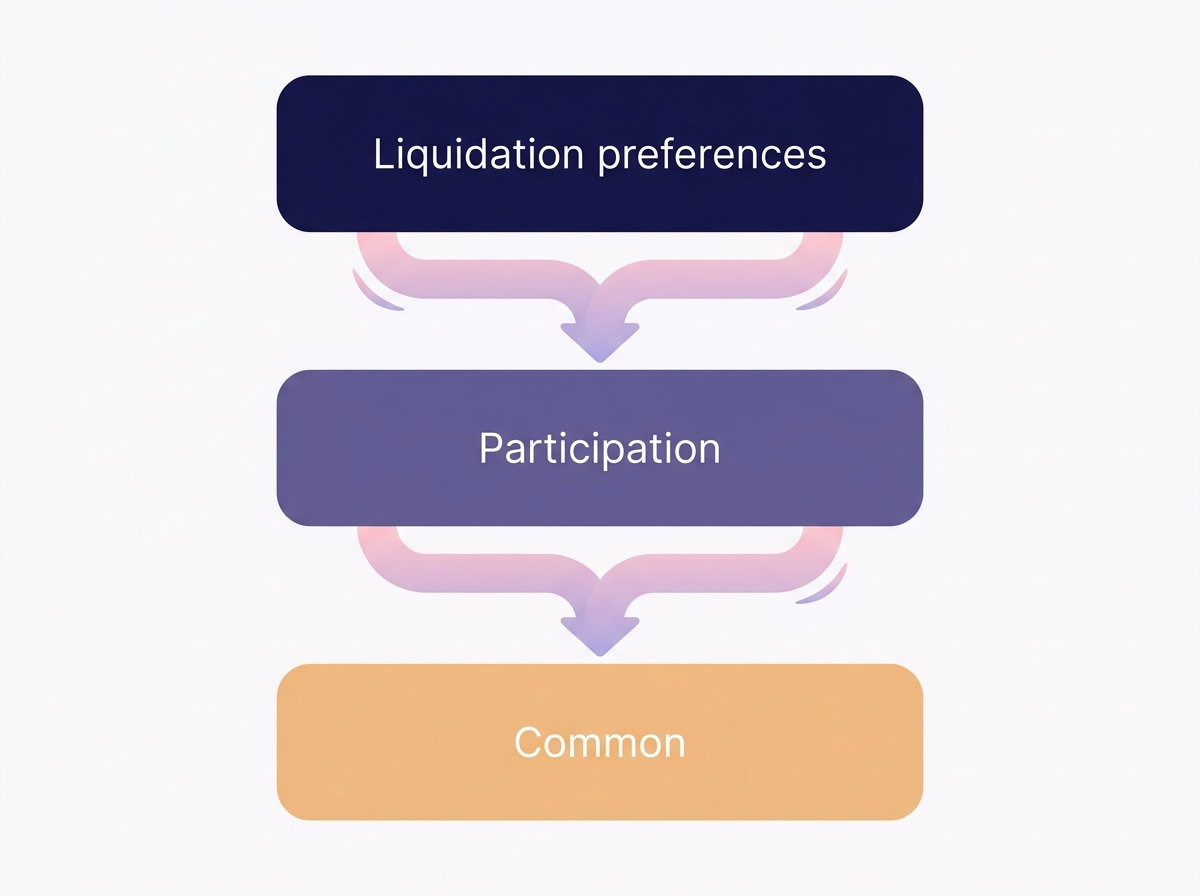
The exit waterfall distributes proceeds in the correct order: senior preferred first, junior preferred next, participation rights, then common. The cap table is the input, the waterfall analysis is the output that founders, employees, and investors actually care about, and what we built Waterfalls.app to make tractable.
The three equity categories
Every cap table breaks ownership into three categories. Treat them with different rules.
Common stock: issued to founders at incorporation (typically at $0.0001-$0.001/share with reverse-vesting provisions) and to employees as direct grants or option exercises. Common is last in liquidation priority, subject to vesting, and carries one vote per share, or more, if the company splits common into Class A vs Class B share classes to concentrate voting control with founders. Models must include unvested shares in fully-diluted calculations but track only vested shares for current economic ownership.
Preferred stock: created in priced rounds (Seed Preferred, Series A, B, C). Each series is its own security class with its own liquidation preference, conversion price, anti-dilution mechanics, and voting profile. Track each series separately. Don’t aggregate.
Option pool: reserved shares for future employee grants. Two crucial distinctions: granted vs ungranted (only granted options live in individual rows, but the full pool affects fully-diluted percentages), and pre-money vs post-money pool top-ups (huge dilution implication, covered below).
| Equity layer | Sits in | Counts toward fully-diluted | Counts toward basic |
|---|---|---|---|
| Founder common (vested) | Cap table rows | Yes | Yes |
| Founder common (unvested) | Cap table rows | Yes | No |
| Preferred (each series) | Cap table rows | Yes | Yes |
| Granted options | Cap table rows | Yes | Vested only |
| Ungranted option pool | Reserve | Yes | No |
| Outstanding SAFEs/notes | Memo line | At conversion | No |
A simple cap table example
The clearest way to read a cap table is as a small table. Below is a cap table example for a startup after a seed round and a priced Series A, showing share counts, basic ownership, and fully-diluted ownership.
Assumptions: two founders hold 8,000,000 common shares; a seed investor holds 1,500,000 seed preferred; a Series A lead buys 3,333,333 Series A preferred; and a 1,166,667-share option pool is reserved (500,000 granted, 666,667 unallocated). Fully-diluted shares total 14,000,000.
| Holder | Security | Shares | Basic % | Fully-diluted % |
|---|---|---|---|---|
| Founders | Common | 8,000,000 | 60.0% | 57.1% |
| Seed investor | Seed preferred | 1,500,000 | 11.2% | 10.7% |
| Series A lead | Series A preferred | 3,333,333 | 25.0% | 23.8% |
| Employees (granted options) | Options | 500,000 | 3.8% | 3.6% |
| Unallocated option pool | Reserve | 666,667 | N/A | 4.8% |
| Total | 14,000,000 | 100.0% | 100.0% |
Basic ownership (13,333,333 shares) excludes the unallocated pool; fully-diluted (14,000,000 shares) includes it, which is why every basic percentage is slightly higher than its fully-diluted counterpart. Investors negotiate against the fully-diluted column.
A cap table can live in three forms: a downloadable template (a one-off spreadsheet, fine for a single round), a maintained spreadsheet (workable through seed), or software (a dedicated platform once transaction volume and 409A obligations grow). The example above is small enough for any of the three; the math, not the format, is what has to be right.
Dilution math, the version that doesn’t break
The fundamental investor-ownership formula uses post-money valuation:
Investor % = Investment ÷ Post-Money Valuation
A $5,000,000.00 investment at $20,000,000.00 post-money = 25.0% for the new investor, leaving existing shareholders with 75.0%. Pre-money and post-money produce different ownership percentages for the same investment, which is why every term sheet should make the valuation method explicit.
Worked Series A: $15,000,000.00 pre-money, $5,000,000.00 raise, $20,000,000.00 post-money. Pre-round 10,000,000 shares at $1.50 each. The new investor receives 3,333,333 shares at $1.50, total 13,333,333 shares post-round, new investor at 25.0%, existing holders pro-rata diluted by the same 25.0%. A founder previously at 40.0% drops to 30.0%; an angel at 20.0% drops to 15.0%.
The dilution itself is just (old shares ÷ total shares after issuance) × 100. The number you compare against is the change, not the absolute. And dilution doesn’t automatically mean economic value falls: if post-money rises faster than your dilution percentage, your equity is worth more in dollars even with a lower ownership share.
Anti-dilution complicates this. Broad-based weighted-average is the market standard for venture rounds: when a company prices a down round, existing preferred holders’ conversion price ratchets down using:
New conversion price = Old price × (A + B) ÷ (A + C)
where A is total fully-diluted shares before the new issuance, B is consideration received, and C is consideration that would have been received at the original price. Models need iterative calculation here because the new conversion price changes the fully-diluted share count, which changes downstream ownership percentages.
SAFEs and the modeling work they create
Post-money SAFEs simplified investor math (a $500,000.00 SAFE at a $10,000,000.00 cap = exactly 5.0% of the company at conversion, regardless of other SAFEs) but moved all the dilution onto founders. Stack three $500,000.00 post-money SAFEs at $10,000,000.00 caps and 15.0% of the company is gone before the priced round arrives. The model needs to track each SAFE separately (cap, discount, MFN status, signing date) and project conversion under multiple Series A scenarios. The variable set matters: an uncapped SAFE has no cap at all, only a discount and MFN, so it converts on the next round’s price alone. Pre-money SAFEs require even more work because their conversion math interacts: each SAFE dilutes the others.
Tooling: where Excel breaks
Excel works through Series A. After that, errors compound faster than diligence can catch them: formulas break on row insertion, version control falls apart across stakeholders, audit trails don’t exist, and every grant, exercise, and transfer needs manual updates.
Specialized platforms (Carta, Pulley, Shareworks) automate 409A workflows, electronic grant agreements, vesting tracking, and stakeholder portals. Practical path: Excel through pre-seed and seed, move to Pulley or Carta around Series A when transaction volume jumps and 409A obligations begin, upgrade further at growth stage if global compliance matters.
A distinction worth stating plainly: these platforms are systems of record; they hold the official cap table, issue shares, and run compliance workflows. Modeling tools sit on top of that record to project dilution and exit outcomes. Founders should keep their official cap table in a dedicated platform (Carta, Pulley) or a carefully-maintained spreadsheet; the modeling layer is a separate job. Waterfalls models dilution and exit waterfalls, and is not a system of record, which is why the equity management platform guidance here stays neutral.
Term-sheet comparison: the actual workflow
The most valuable thing a model does for founders is comparing competing term sheets side by side. Higher pre-money valuation isn’t always the better deal; the structure around it usually matters more.
A real comparison. Offer A: $18,000,000.00 pre-money, $5,000,000.00 check, 1× non-participating, broad-based weighted-average anti-dilution, no option pool top-up. Offer B: $20,000,000.00 pre-money, $6,000,000.00 check, 1× participating, full ratchet anti-dilution, 5% pool top-up required. Offer B looks better on pre-money. After modeling: Offer A leaves founders with materially more equity, milder anti-dilution exposure, no immediate dilution from a pool top-up, and far better outcomes in the $30M-$75M exit range where participating preferred bites hardest. The valuation gap doesn’t compensate.
Run a sensitivity analysis on dilution at each pre-money option in $2,500,000.00 increments and you’ll see where the curves cross. Then run the waterfall analysis at $30M, $75M, and $150M exits to see what each shareholder actually receives. Founders almost always sign the wrong term sheet when they look only at the headline number.
Mistakes that show up in diligence
Investors commonly cite cap table errors as a reason deals stall or fail before Series A. These five recur across diligence cycles:
- Option pool treatment. A “20% post-money pool on $15M pre-money” usually means the $15M pre-money already includes the expanded pool. Founders bear the dilution from the top-up, not new investors. Confirm the pre-money/post-money pool point in the term sheet itself.
- Missing ungranted options in fully-diluted. Excluding the unallocated pool overstates current ownership.
- Vesting calculation errors. Wrong start dates, missed cliffs, or lost acceleration provisions show up in employment disputes.
- Stale conversion prices after anti-dilution events. Models must auto-update preferred conversion prices when down rounds trigger weighted-average adjustments and re-run the convertible preferred stock conversion math each time.
- Liquidation preference stacks calculated wrong. Order matters (senior first), and participation caps require step-down logic. Errors in the liquidation preference stack directly mis-state the exit waterfall, and at exit they cost founders and employees real money.
A 60-second validation checklist: ownership percentages sum to exactly 100%, fully-diluted includes all options and convertibles, liquidation preferences match each term sheet, vesting matches every grant agreement, and the waterfall distributes the exact exit amount with no rounding gap.
This article is general information about cap tables and equity modeling, not legal, tax, or accounting advice. Equity structures are fact-specific; confirm your cap table, term-sheet, and 409A treatment with your counsel and accountants before relying on any model or grant decision.
Frequently asked questions
What is a cap table?
A cap table (capitalization table) is the ledger of who owns what in a company: every shareholder, their securities (common, preferred, options, warrants, SAFEs), share counts, and basic and fully-diluted ownership percentages. It is the single source of truth for fundraising, dilution, and exit decisions.
Why is it called a cap table?
Short for capitalization table. It records the company’s capitalization: its equity and capital structure, and who holds it. “Cap” is simply the abbreviation of “capitalization.”
Do all companies have a cap table, and can an LLC have one?
Any company with more than one owner effectively has one. C-corps almost always maintain a formal cap table built on shares. LLCs use a membership or unit ledger that does the same job with units and capital accounts instead of shares; same idea, different instruments.
What’s the difference between basic and fully-diluted ownership?
Basic includes only issued shares and vested options. Fully-diluted assumes every option, warrant, and convertible converts to common. Fully-diluted percentages are always lower and are what investors negotiate against.
How often should I update the cap table?
Immediately after every transaction (round, grant, exercise, transfer, cancellation) and a full validation review at least quarterly, even without new transactions.
Do option pools dilute founders or investors?
Pre-money pool top-ups dilute founders, because the pre-money valuation includes the expanded pool. Post-money top-ups dilute everyone proportionally. Term sheets should specify which.
What happens to the cap table in a down round?
Anti-dilution provisions trigger conversion-price adjustments that issue additional preferred shares to existing investors, further diluting common holders. The exact mechanics depend on whether anti-dilution is broad-based weighted-average, narrow-based, or full ratchet.
What’s the best cap table software for early stage?
Pulley or Carta. Pulley is simpler and cheaper; Carta scales better through growth stage. Both are systems of record that hold the official cap table; for modeling dilution and exits on top of that record, a dedicated modeling tool does the projection work.
The bottom line
A cap table is the source of truth for who owns what, and the input to every consequential equity decision: how the next round dilutes each holder, how option grants are priced, and what each shareholder receives at exit. The record is necessary, but the harder question is what the structure means under pressure, and that is a modeling question.
Waterfalls models dilution and exit-waterfall distributions directly from a cap table. It is the modeling layer, not the record; it won’t replace Carta or Pulley and won’t host your official cap table, but it shows what the structure means for founders and employees at each outcome.