

A convertible note is a short-term debt instrument that automatically converts into equity at a company’s next priced financing round. The investor wires money, receives a promissory note that accrues interest, and at the next qualifying round their loan principal plus accrued interest converts into preferred stock, usually at a discount to that round’s price, capped at a pre-agreed valuation, or both.
Convertible notes are the older sibling of the SAFE. Y Combinator introduced the SAFE in 2013 specifically as a simpler alternative, but convertible notes are still widely used, especially outside the US, in bridge financings between rounds, and where lenders want the legal protection of debt instead of a contractual right to future equity.
Definition: A convertible note is a debt instrument issued by a company to an investor that converts into equity at a future qualifying financing event, typically with an interest rate, maturity date, valuation cap, and discount.
How a convertible note converts
The conversion is event-driven. At a qualified financing (usually defined as a priced equity round above some threshold: $1M, $2M, sometimes $5M), the note’s principal plus accrued interest converts into the same series of preferred stock the new investors are buying, but at a better price.
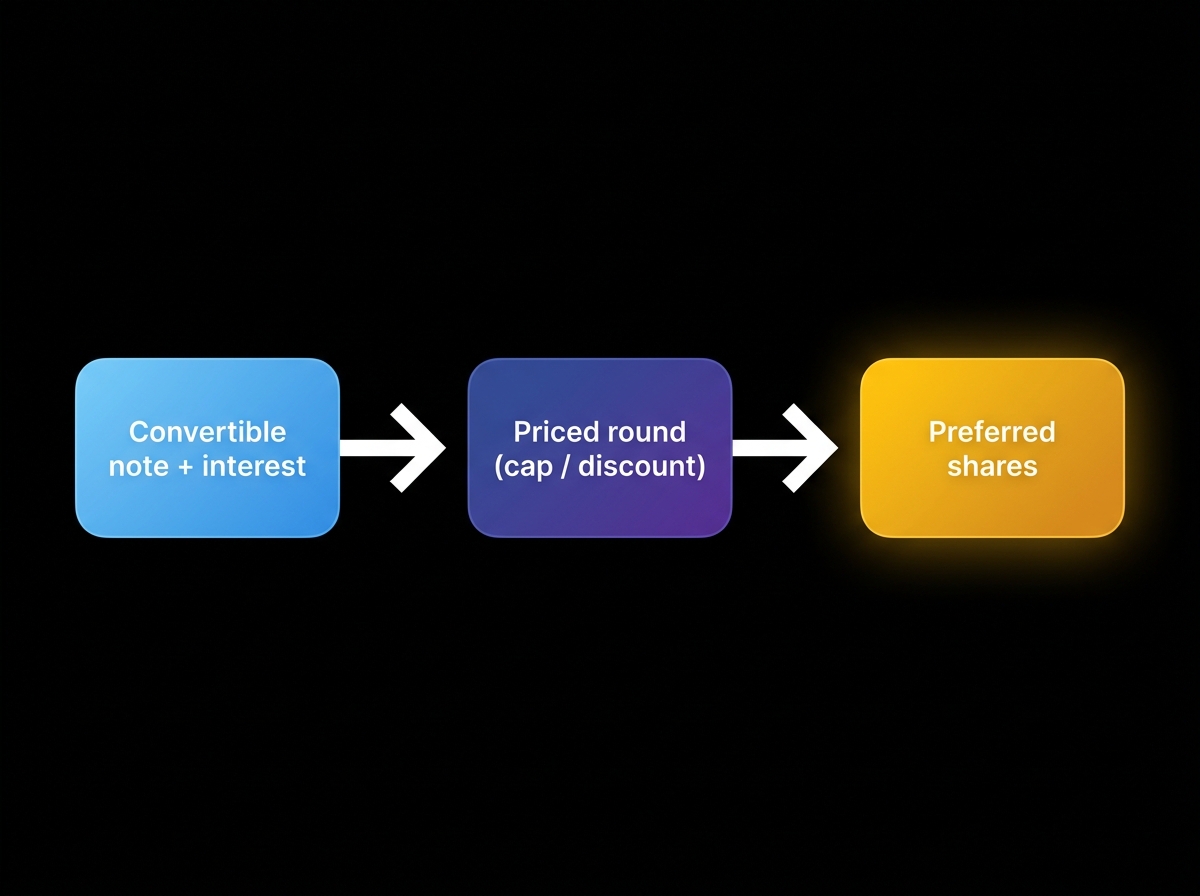
That “better price” is set by whichever of three mechanisms gives the noteholder more shares:
- Discount only. The note converts at a percentage discount to the round’s per-share price. A 20% discount means the noteholder pays $0.80/share when new investors pay $1.00/share. They get 25% more shares for the same money, the same economics as an uncapped SAFE, which also converts on a discount alone.
- Valuation cap only. The note converts as if the company were priced at the cap, regardless of the actual round price. A $5M cap when the round prices at $20M means the noteholder converts at 4× the as-converted ownership of new investors.
- Cap + discount, whichever is better. The noteholder gets to use whichever mechanism produces the lower per-share conversion price.
Worked example: $100,000 convertible note, 5% annual interest, 20% discount, $5M valuation cap. After 12 months the company raises a Series A at $20M post-money with $1.00/share.
- Principal + interest = $100,000 × 1.05 = $105,000.
- Discount path: $1.00 × 0.80 = $0.80/share → 131,250 shares.
- Cap path: $5M / 20M × $1.00 = $0.25/share → 420,000 shares.
- Cap wins. Noteholder converts at $0.25/share and ends up with 420,000 shares of Series A.
Compared to a new investor wiring the same $105,000 at $1.00/share (105,000 shares), the convertible noteholder gets 4× the shares, the reward for taking earlier risk.
Convertible note vs SAFE
Both instruments do roughly the same job (defer pricing the round), but the legal mechanics differ.
| Feature | Convertible note | SAFE |
|---|---|---|
| Legal form | Debt | Forward contract for equity |
| Interest | Yes (typically 4-8% annual) | No |
| Maturity date | Yes (typically 18-24 months) | No |
| Investor risk if no qualifying round | Note becomes payable on maturity | SAFE sits indefinitely |
| Investor priority in bankruptcy | Senior to equity | Equity-tier |
| Common form | Custom or NVCA template | Y Combinator standard |
| Geographic preference | Stronger outside US | Dominant in US since 2018 |
The consequence is investor risk allocation. A SAFE leaves the holder with a contract and no immediate enforcement option if the company never raises a priced round. A convertible note holder can, at maturity, demand repayment of principal plus interest, force a conversion at a default price (often the cap), or sue for breach. That’s a meaningful protection in shaky deals. See SAFE agreements and post-money SAFEs for the SAFE-specific mechanics, or the full head-to-head in SAFE vs convertible note.
Key terms in a convertible note
Five terms drive almost every convertible note negotiation:
- Principal. The amount the investor wires.
- Interest rate. Accrues on the principal until conversion. Most US notes are 4-8% simple annual interest. Interest is paid in equity, not cash; it’s added to the principal at conversion.
- Maturity date. The date by which the note must convert or be repaid. Typically 18-24 months. If a qualifying round hasn’t happened by maturity, the note holder can demand repayment, force conversion at the cap, or extend.
- Valuation cap. The maximum company valuation at which the note converts. Lower caps favour the investor.
- Discount rate. The percentage discount to the next round’s price. Typically 15-25%.
A handful of less-common terms appear in bridge or pre-seed rounds: MFN clauses (note auto-adopts better terms of any future note), conversion floor (minimum company valuation at conversion, protecting the founder), and change-of-control multiples (typically 1.5× or 2× principal repaid in cash if the company sells before the note converts).
When founders should choose a convertible note over a SAFE
Three situations push founders toward convertible notes:
- International investors. SAFEs are a US-specific instrument and not always recognized cleanly under non-US securities law. A convertible note (debt) is universally recognized.
- Sophisticated angels demanding maturity protection. Some investors want the contractual right to call back their money if the company stalls. A SAFE doesn’t give them that; a note does.
- Bridge rounds between priced financings. Company has raised a Series A and is bridging to Series B with existing investors. A short note (12-month maturity, low cap, modest interest) keeps the bridge clean and the conversion deterministic.
For first-money pre-seed in the US, SAFEs typically win on simplicity. For everything else, convertible notes are still common.
How convertible notes interact with cap tables and waterfalls
Once converted, a convertible note’s resulting preferred stock behaves like any other Series A (or Series Seed) preferred, with the same liquidation preference, same conversion rights, and same waterfall behaviour. See convertible preferred stock for the full mechanics.
The pre-conversion accounting is the awkward part. A note sitting on the balance sheet is debt: it’s a liability, not equity, and shows up in the company’s financials accordingly. For exit modeling and cap table calculations, most teams build the note’s as-converted shares into a parallel “fully-diluted” view so they can model exit outcomes consistently regardless of whether the conversion has actually triggered yet.
In a sale before any priced round, the note typically converts at the cap (or some pre-agreed multiple of principal) and joins the exit waterfall as preferred stock for purposes of distributing proceeds.
Frequently asked questions
What’s the difference between a convertible note and a SAFE?
A convertible note is debt: it has interest, a maturity date, and the holder is a creditor of the company until conversion. A SAFE is a contract for future equity with no interest, no maturity, and no creditor status. Notes give investors more downside protection; SAFEs are simpler and faster to close.
What happens if a convertible note hits maturity without a priced round?
Three options, all spelled out in the note: (1) the note holder can demand repayment of principal plus accrued interest, (2) the note converts at a default price (usually the cap, sometimes a pre-agreed valuation), or (3) the parties extend the maturity by mutual agreement. Founders typically negotiate hard for option (2) since cash repayment can be terminal.
Does interest on a convertible note get paid in cash?
Almost never. Standard convertible notes accrue interest until conversion, then convert principal + accrued interest into equity. The holder ends up with more shares, not a cash payment.
What’s a typical convertible note interest rate?
4-8% simple annual interest in the US, usually 5-6%. Outside the US it can be higher (8-12%) where local rates and risk premiums push up cost of debt.
How big is the discount on a convertible note?
Typically 15-25%. 20% is the most common single number. The discount is the noteholder’s reward for taking earlier risk than the next-round investors.
Can convertible notes have anti-dilution protection?
Pre-conversion, no. They don’t have shares to dilute. After conversion, the resulting preferred stock often inherits the new round’s anti-dilution protection (broad-based weighted average is standard).
Are convertible notes still used in 2026?
Yes, particularly outside the US, in bridge rounds, and where investors want creditor-tier protection. SAFEs dominate US first-money pre-seed, but convertible notes remain widely used.