

Multiple on Invested Capital (MOIC) is a private-equity and venture-capital return metric equal to the total value created by an investment (realized distributions plus unrealized current value) divided by the capital invested. It is expressed as a multiple, so a 3.0x MOIC means every $1.00 invested produced $3.00 of total value. MOIC measures the magnitude of returns and ignores the time value of money.
This guide covers the MOIC formula, how to calculate it step by step, the gross-versus-net and invested-versus-committed distinctions that trip people up, how MOIC sits next to TVPI, DPI, RVPI and IRR, and what counts as a good MOIC by asset class.
The short version:
- What it is: total value (distributions + current value) divided by invested capital, shown as a multiple.
- The formula: MOIC = (Distributions + Current Value) ÷ Invested Capital.
- What a 3.0x means: $3.00 of total value for every $1.00 invested (a 200.0% gain).
- What is “good”: roughly 2.0x-3.0x net for PE buyout; top-quartile VC runs higher (often 3.0x-5.0x+).
- MOIC vs IRR in one line: MOIC is the size of the return; IRR is the speed. A 3.0x MOIC is ~73% IRR over 2 years or ~12% over 10.
What is MOIC (Multiple on Invested Capital)
Definition: Multiple on Invested Capital (MOIC) is the ratio of the total value an investment has created (cash distributions received plus the current fair-market value of holdings still held) to the capital invested, expressed as a multiple showing how many times the original investment has been returned.
MOIC provides a straightforward measure of absolute return. A MOIC of 2.5x means an investor received $2.50 of total value for every $1.00 invested. Unlike time-weighted metrics such as IRR, MOIC measures only the magnitude of the return, regardless of how long the capital was at work.
MOIC captures both realized and unrealized value. It includes cash distributions already paid out plus the current fair-market value of remaining holdings. The canonical illustration: $1,000,000 invested that grows into $3,000,000 of total value is a 3.0x MOIC. That comprehensive view makes MOIC useful for tracking performance throughout the investment lifecycle, not only at exit.
Key insight: MOIC answers “how many times did this investment multiply the capital?” in a single number, without any time-value calculation.
MOIC formula
MOIC = Total Value (Distributions + Current Value) ÷ Invested Capital
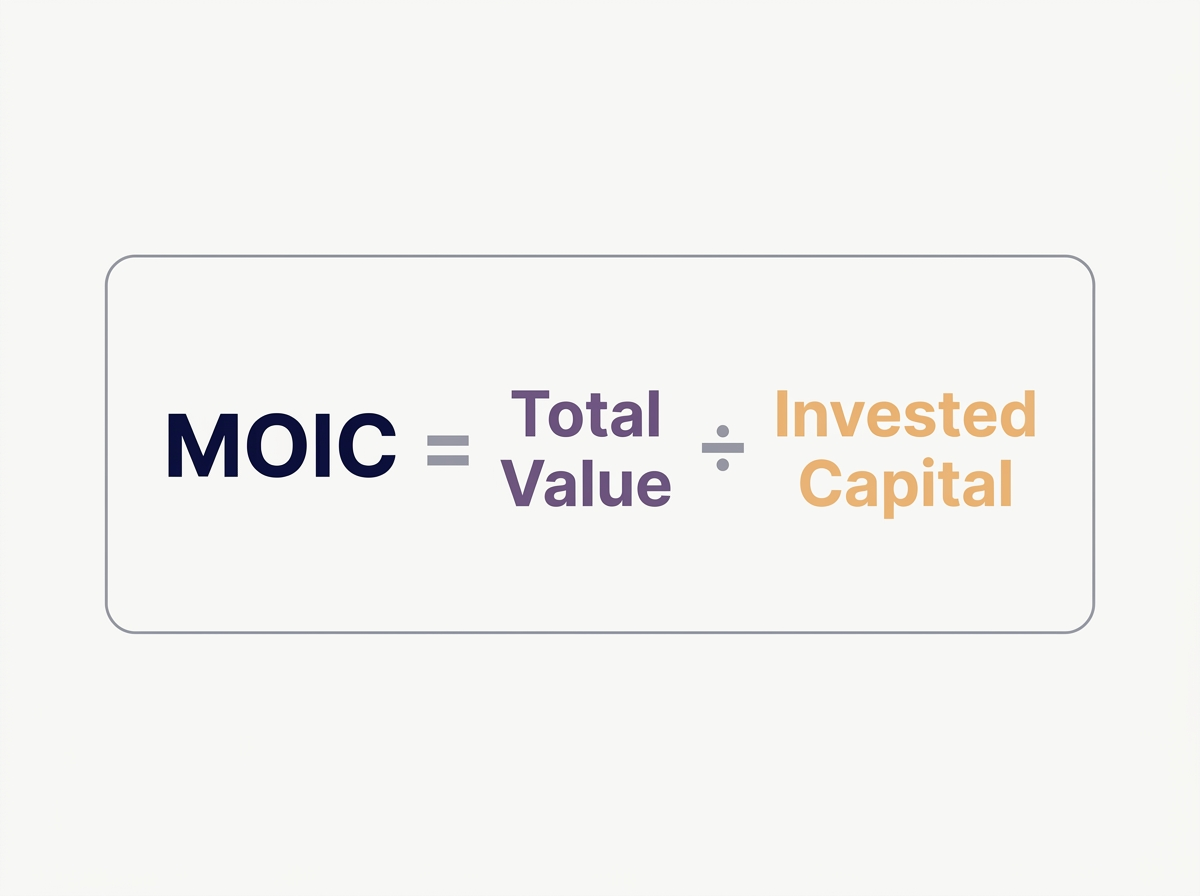
Where:
- Distributions: cash already returned to the investor (dividends, partial exits, recapitalizations, the proceeds of a full exit).
- Current Value: the latest fair-market value of holdings still owned, from the most recent valuation or 409A appraisal.
- Invested Capital: the actual capital deployed: the original investment plus any follow-on investments.
The result is a multiple expressed as “x” (for example 3.2x, 0.8x, or 5.0x). Total Value is the sum of what has been paid out and what is still held, so MOIC reflects performance to date even before an investment is fully realized.
Warning: Only include capital actually deployed in the denominator. Management fees, carried interest, and operating expenses are not part of invested capital for a gross MOIC; how those costs are treated is what separates gross MOIC from net MOIC, covered below.
How to calculate MOIC
Calculate MOIC in five steps:
- Sum all cash distributions received to date: dividends, partial exits, and recapitalization proceeds.
- Determine current value of holdings still owned, using the latest valuation or 409A appraisal.
- Calculate total value by adding distributions and current value.
- Sum invested capital: the original investment plus all follow-on investments.
- Divide total value by invested capital and express the result as a multiple.
A worked example: an investor has received $1,500,000 in distributions and holds remaining positions valued at $3,500,000, for a total value of $5,000,000. Against $2,000,000 of invested capital (original plus follow-ons), MOIC is $5,000,000 ÷ $2,000,000 = 2.5x. Every $1.00 invested has produced $2.50 of total value.
Key insight: MOIC changes continuously as valuations update and distributions occur. Tracking it quarterly shows the trend; the figure is only final once the investment is fully realized.
Gross vs net MOIC and which capital to use
The single most common MOIC error is using the wrong denominator. The denominator is invested (deployed) capital (the capital actually put to work), not committed capital. A limited partner may commit $10,000,000 to a fund, but if only $7,000,000 has been called and deployed, MOIC is measured against the $7,000,000 that is actually at work. Committed-but-uncalled capital is not yet invested, so including it understates the multiple. (TVPI, covered in the next section, is the metric that measures against an LP’s total paid-in capital.)
The second distinction is gross versus net. Gross MOIC is calculated before management fees and carried interest; it measures the performance of the underlying investments. Net MOIC is calculated after fees and carry are deducted; it measures what the investor actually keeps. Gross MOIC is always equal to or higher than net MOIC, and a fund should state which it is reporting. When a benchmark says “2.0x,” it matters whether that is gross or net, because the gap between them can be half a turn or more.
MOIC vs TVPI, DPI & RVPI
MOIC belongs to a family of return multiples that appear together on a limited-partner report. Each divides a different numerator by a different base, and each answers a different question.
- MOIC: total value ÷ invested (deployed) capital. Often quoted gross and at the deal or portfolio-company level. It asks: how many times did the deployed capital multiply?
- TVPI (Total Value to Paid-In): total value ÷ LP paid-in capital. The LP-level, typically net-of-fees view. It asks: how many times has the fund grown the money the LP actually paid in?
- DPI (Distributions to Paid-In): realized distributions ÷ paid-in capital. Cash actually returned, ignoring unrealized marks. It asks: how much money has come back so far?
- RVPI (Residual Value to Paid-In): unrealized current value ÷ paid-in capital. The marks still on the books. It asks: how much value is still unrealized?
The identity that ties the LP metrics together is TVPI = DPI + RVPI: total value is realized cash plus unrealized residual.
| Metric | Numerator | Denominator | Answers |
|---|---|---|---|
| MOIC | Distributions + current value | Invested (deployed) capital | Multiple on capital put to work (often gross) |
| TVPI | Distributions + current value | LP paid-in capital | Total fund multiple to the LP (net) |
| DPI | Distributions only | LP paid-in capital | Cash actually returned |
| RVPI | Current value only | LP paid-in capital | Value still unrealized |
The practical difference between MOIC and TVPI is the denominator and the fee treatment: MOIC is usually a gross, deployed-capital deal multiple, while TVPI is a net, paid-in LP multiple. DPI matters most as a fund matures. A high TVPI carried by RVPI is paper value, whereas DPI is cash in hand. MOIC tells you the multiple at the end; the distribution waterfall determines how exit proceeds actually reach each holder before that multiple is reported.
MOIC vs IRR
MOIC and Internal Rate of Return (IRR) measure different things. MOIC is the size of the return as a multiple and ignores timing; IRR is the time-weighted annualized rate of return and is highly sensitive to when cash moves. In one line: MOIC is how much, IRR is how fast.
The same MOIC implies very different IRRs depending on the holding period. A 3.0x MOIC achieved in 2 years is approximately 73% IRR; the identical 3.0x MOIC achieved over 10 years is only about 12% IRR. MOIC is time-blind, while IRR incorporates the time value of money.
MOIC is harder to game with distribution timing. A fund can flatter its IRR by accelerating early distributions, because IRR rewards cash returned sooner. MOIC is immune to that: it reports the same total multiple regardless of when distributions land, which is why the two are read together.
Quick summary: MOIC gives the absolute multiple and IRR the time-adjusted rate; reporting both, alongside the holding period, keeps either number from telling half the story.
MOIC vs ROI
Return on Investment (ROI) and MOIC describe the same outcome in different units. MOIC divides total value by invested capital ($3,000,000 ÷ $1,000,000 = 3.0x); ROI subtracts the original investment first and reports a percentage (($3,000,000 − $1,000,000) ÷ $1,000,000 = 200.0%). The relationship is exact: MOIC = (ROI% ÷ 100) + 1, so a 3.0x MOIC equals a 200.0% ROI.
Private-equity and venture-capital professionals favor MOIC because it states the multiple directly (“we tripled the capital”), which communicates absolute value creation to limited partners more cleanly than a percentage.
What is a good MOIC?
A good MOIC is roughly 2.0x-3.0x net of fees for a private-equity buyout fund; top-quartile venture-capital funds run higher, often 3.0x-5.0x+. What counts as good always depends on the holding period and on whether the figure is gross or net.
Private equity benchmarks
Across published Cambridge Associates and PitchBook benchmarks, private-equity MOIC for large buyouts runs about 2.3x-3.0x+ at the top quartile, 1.8x-2.3x at the median, and below 1.5x at the bottom quartile. Middle-market and small-buyout strategies sit slightly higher at the top end (around 2.2x-3.0x+) but follow the same distribution shape. Smaller deals target higher MOIC to compensate for illiquidity and execution risk; larger deals accept lower MOIC given reduced execution risk.
Venture capital benchmarks
Venture top-quartile multiples are materially higher: seed and pre-seed funds around 4.0x-6.0x+, Series A-B around 3.5x-5.0x+, and growth-stage around 2.5x-3.5x, per PitchBook and Preqin venture benchmark data. Medians sit far below the top quartile because venture returns follow a power law. A small share of investments generates the vast majority of fund returns. Early-stage funds depend on a few outsized winners to offset numerous write-offs; the top-line waterfall analysis of distributions reflects that asymmetry. A widely cited example is Sequoia’s roughly $60M into WhatsApp, reported at about $3B when Facebook acquired the company in 2014, on the order of a 50x gross MOIC.
This article is general information about MOIC as a performance metric, not investment, tax, or accounting advice. Fund-return calculations are methodology-dependent (gross vs net, realized vs unrealized); confirm definitions with the fund’s reporting standards and your advisors before relying on any figure.
MOIC in practice: reporting and follow-on decisions
MOIC is a primary metric for reporting fund performance to limited partners, calculated and reported quarterly alongside IRR. It also feeds the carried interest calculation: the gross multiple on the underlying deals, net of fees and carry taken at the fund level, is what produces the net MOIC an LP actually keeps. Fund managers calculate it at three levels:
- Individual investment MOIC: tracks each portfolio company separately to identify winners and guide follow-on decisions.
- Fund-level MOIC: aggregates all portfolio companies into total fund performance.
- Vintage-year MOIC: compares funds raised in the same year to control for market conditions.
MOIC also guides whether to deploy additional capital into an existing position. For a strong performer (current MOIC 3.0x+), a follow-on increases ownership but can dilute an excellent return if the entry valuation is high, so the marginal MOIC on the new capital is calculated on its own. For a moderate performer (1.5x-2.5x), the question is whether additional capital can accelerate growth relative to other opportunities. For a poor performer (below 1.0x), follow-on is generally avoided unless bridge financing is needed to reach an exit milestone.
The per-holder MOIC follows from the proceeds each party receives. Once you know how a liquidity event splits across preferred and common, and how carried interest is taken at the fund level, Waterfalls models option pools, dilution, and exit-waterfall distributions from your cap table. It does not report a fund’s official MOIC and is not a fund-administration or returns-reporting system; official gross and net MOIC should come from the fund’s books and administrator. What Waterfalls shows is what each exit scenario returns to founders, employees, and investors.
MOIC limitations
MOIC is useful but incomplete, and four limitations matter most:
1. Time blindness. MOIC ignores the time value of money. A 2.5x MOIC in 2 years is far better than 2.5x in 10 years, but MOIC treats them identically. It should be read alongside IRR and the holding period.
2. Valuation subjectivity. Unrealized value depends on fair-market-value estimates that can be soft, especially when convertible preferred stock with a senior liquidation preference sits above common in the cap stack and absorbs proceeds first.
3. No risk adjustment. A 3.0x from late-stage growth involved far less risk than 3.0x from seed stage, but MOIC treats them as equal.
4. Distribution and capital-call timing. MOIC gives no credit for early distributions that enable reinvestment versus a lump-sum exit at fund liquidation, and it does not reflect the timing of capital calls or how NAV moved between valuation dates.
Warning: Unrealized MOIC can evaporate quickly. The 2022 venture correction saw many portfolio companies marked down 40%-70%, sharply reducing reported MOIC that had never been realized in cash.
Frequently asked questions
What does MOIC mean?
MOIC stands for Multiple on Invested Capital. It is the ratio of total value created (realized distributions plus the unrealized current value of holdings) to the capital invested, expressed as a multiple. A 3.0x MOIC means every $1.00 invested returned $3.00 of total value.
What is a 3x MOIC?
A 3.0x MOIC means the investment returned three times the capital deployed: $3.00 of total value for every $1.00 invested, equal to 300.0% of capital and a 200.0% gain. Whether a 3.0x is good depends on the holding period: over 2 years it is roughly a 73% IRR, but over 10 years only about 12%.
What is a good MOIC?
For private-equity buyout funds, about 2.0x-3.0x net of fees is strong, with top-quartile funds reaching 2.3x-3.0x+. Venture-capital top quartile runs higher, often 3.0x-5.0x+, because venture returns follow a power law. A MOIC should always be read with IRR and the holding period.
How is MOIC different from IRR?
MOIC measures absolute return as a multiple and ignores timing; IRR measures the time-weighted annualized rate of return. The same 3.0x MOIC is about a 73% IRR over 2 years or about 12% over 10 years. MOIC is the size of the return, IRR is the speed, and the two are reported together.
What is the difference between MOIC, TVPI and DPI?
All three are return multiples. MOIC compares total value to invested (deployed) capital and is often quoted gross. TVPI compares total value to an LP’s paid-in capital and is typically net of fees. DPI counts only realized distributions divided by paid-in capital, which is the cash actually returned. The identity is TVPI = DPI + RVPI.
Can MOIC be less than 1.0x?
Yes. A MOIC below 1.0x means the investment lost money. A 0.6x MOIC means investors recovered only $0.60 of total value per $1.00 invested (a 40.0% loss), while a total loss is 0.0x. Any value between 0.0x and 1.0x reflects partial recovery.
The bottom line
MOIC is the clearest single measure of absolute return in private equity and venture capital: total value created divided by capital invested, stated as a multiple. Its strength is also its limit. By ignoring time, fee structure, and risk, it must be read alongside IRR, DPI, and the holding period, and reported clearly as gross or net.
MOIC summarizes the multiple at the end of a deal; what produces it is the distribution that splits exit proceeds across the cap table. Waterfalls models option pools, dilution, and exit-waterfall distributions from a cap table, so you can see what each scenario returns to founders, employees, and investors before that multiple is ever reported. It does not produce a fund’s official MOIC and is not a returns-reporting system; it shows what the proceeds mean for each holder at every outcome.