

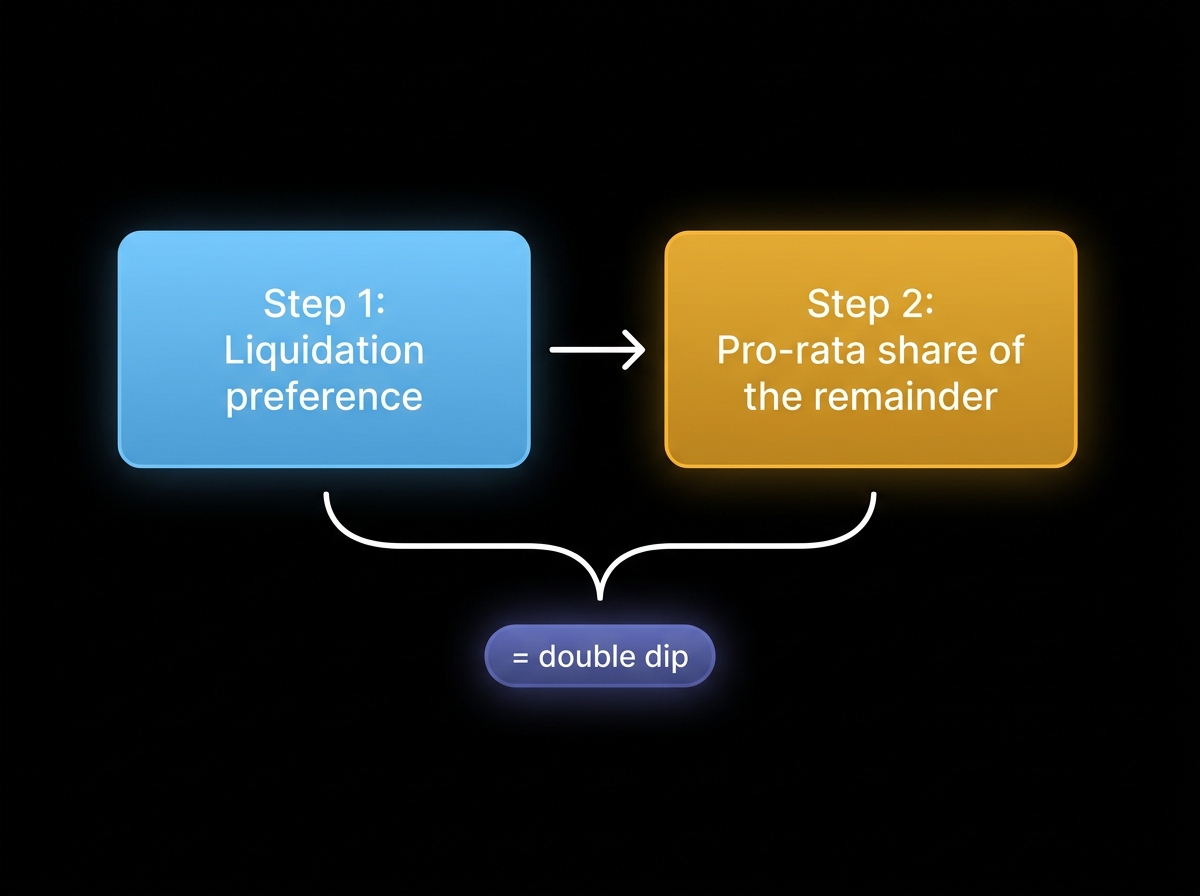
Participating preferred stock is the term-sheet provision that lets investors get paid twice on the way out: first their liquidation preference, then a pro-rata share of whatever’s left as if they’d already converted to common. It’s the “double dip,” and on a moderate exit it can swing tens of millions in either direction.
Below: how the math actually works, why founders push for non-participating or capped participation, and worked examples so you can see exactly where the structure pays off vs where it just shifts proceeds away from common.
What participating preferred actually does
Participating preferred is convertible preferred stock with two stacked rights at exit:
- Liquidation preference paid first: usually 1× the original investment, sometimes 1.5× or 2× in distressed or down rounds.
- Pro-rata participation in the remainder: based on as-converted ownership percentage, without the holder having to choose between the preference and conversion.
Non-participating preferred forces a binary choice at exit: take the preference, or convert to common and share pro-rata. Participating preferred eliminates that choice and lets investors collect both. That’s why it matters most in moderate exits (say, 1.5 to 4× total invested capital) where the gap between “take preference” and “convert and share” is largest.
The double-dip, on real numbers
Take a company with $10M of participating preferred at 1× preference, sitting at 40% as-converted ownership, and an exit at $30M. The waterfall:
- First $10M to preferred (the liquidation preference).
- Remaining $20M split pro-rata: 40% to preferred ($8M), 60% to common ($12M).
- Preferred takes $18M (60% of exit). Common takes $12M (40%).
Despite owning 40% on paper, the preferred investor walks away with 60% of the proceeds. That’s the double-dip in one paragraph.
The advantage is largest at mid-range exits and shrinks as outcomes scale. For the same $10M / 40% investor: at a $15M exit non-participating returns $10M (1×) versus $12M (1.2×) participating, +20%. At $25M, $10M vs $14M (1.4×), +40%. At $50M, $20M vs $26M (2.6×), +30%. At $100M, $40M vs $46M (4.6×), +15%. At $100M+ the math approaches “convert and share pro-rata” anyway, so the structural premium narrows. At $25M, the sort of acqui-hire-adjacent exit that’s common in venture portfolios, the double-dip is meaningful.
Where the break-even sits for non-participating
If the preferred is non-participating, the investor takes the preference up to a break-even point and converts above it. The line is:
Break-even exit = liquidation preference ÷ as-converted ownership %
A $20M investment at 25% ownership breaks even at $80M. Below $80M the investor takes their $20M. Above $80M they convert to common and share in the upside. With participating preferred, that switch never happens; the investor takes both pieces at every exit value, which is why the structure shifts so much money away from common in the $20M-$80M zone.
What founders actually negotiate: caps
Pure participating preferred is rare on healthy Series A/B rounds in normal markets. The middle ground that almost always appears is the participation cap: a return multiple at which the participation right falls away and the investor reverts to non-participating economics.
A 3× cap on a $10M investment means the investor takes whichever is lower:
- 3× the investment ($30M), or
- The full participating-preferred calculation.
At a $10M investment with 30% ownership, 1× preference:
| Exit | Uncapped participating | 2× cap | 3× cap |
|---|---|---|---|
| $30M | $13M | $12M (capped) | $13M |
| $50M | $17M | $12M (capped) | $17M |
| $100M | $24M | $12M (capped) | $12M (capped) |
| $200M | $34M | $12M (capped) | $12M (capped) |
Two practical patterns:
- 2× caps are most founder-friendly and tend to appear when founders have leverage: competitive Series A/B rounds, multiple term sheets, hot sectors.
- 3× caps are the closest thing to a market default in normal venture rounds.
- Uncapped participating typically appears in down rounds, bridge financing, and distressed deals, situations where investors are pricing additional risk.
A useful negotiation lever: a 10-20% higher pre-money valuation on non-participating preferred often beats accepting participation at a lower valuation. Model it both ways before signing.
Multi-round waterfalls compound the drag
The damage to common compounds when multiple rounds carry participation rights at different preferences. Company XYZ raised three rounds:
- Series A: $5M, 20%, 1×, uncapped participating
- Series B: $15M, 25%, 1.5×, 3× cap
- Series C: $30M, 30%, 2×, non-participating
At a $120M exit, preferences are paid in seniority order first ($60M Series C + $22.5M Series B + $5M Series A = $87.5M). The remaining $32.5M splits pro-rata among the participating classes and common: Series A takes $6.5M, Series B takes $8.125M (within its 3× cap), and common takes the rest. Final proceeds:
- Series C: $60M
- Series B: $30.625M
- Series A: $11.5M
- Common: $17.875M
Common ends up with under 15% of a $120M exit despite holding the majority of fully-diluted shares, the predictable consequence of stacked preferences plus participation. This is exactly the kind of math that waterfall analysis and cap table modeling are built to surface before you sign the term sheet.
What it means for founders, employees, and option holders
For founders, the cost of participating preferred is concentrated in moderate exits. At $20M-$75M outcomes, where a meaningful share of venture exits actually land, participation can cut founder proceeds by 30-40% versus non-participating with the same valuation. Always model exit scenarios at 2×, 5×, and 10× invested capital before signing.
For employees with options, participating preferred raises the effective strike-price overhang. The same exit produces a smaller pool for common, which drags option payouts. An employee holding 0.1% of the option pool sees the value of those options fall by roughly the same percentage that participation pulls away from common in the relevant exit range.
For investors, participating preferred is straightforward downside protection plus enhanced upside in the most likely exit zone. Even capped versions outperform non-participating in mid-range exits, which is why the structure persists despite founder pushback.
A reasonable founder checklist before agreeing:
- Push for a cap (target 2-3×) before agreeing to participation.
- Compare a 10-15% valuation bump on non-participating to capped participation at the lower number.
- Model the liquidation preference rights stack across all rounds, not just this one.
- Negotiate sunset provisions where participation expires after a defined date or milestone.
- Expand the option pool if participation is going to compress employee outcomes.
Frequently Asked Questions
How does participating preferred affect employee stock options? Employee options become less valuable because participation pulls proceeds away from common shareholders, raising the break-even exit value at which options pay out meaningfully.
Can participation rights be capped? Yes; the standard tool is a return multiple (typically 2× or 3×). Above that multiple the investor reverts to non-participating economics, which usually means converting to common.
When do non-participating investors convert to common? At exit, when the common-stock value of their as-converted ownership exceeds the preference. Break-even = preference ÷ ownership %.
What’s the difference between pari passu and stacked preferences? Pari passu means same-class preferred holders share preferences equally. Stacked preferences create seniority: Series C gets paid before Series B before Series A.
How do I model exit scenarios for negotiating participation? Run waterfalls at 2×, 5×, and 10× invested capital. Compare founder and employee returns under participating vs non-participating with offsetting valuation bumps. The right structure is whichever gives common the better expected value across the realistic exit range.