

Vested means you fully own something you have earned over time, and it cannot be taken back. In compensation, employer-granted equity or retirement benefits vest gradually as you stay employed; once vested, they are yours to keep even if you leave. Fully vested means you own 100%, with nothing left to forfeit.
A vesting schedule is the set of rules that decides when those benefits (stock options, RSUs, retirement contributions) actually become yours. This guide covers what “vested” means in plain terms, the standard four-year schedule with a one-year cliff, the three schedule types, acceleration, and what happens to unvested equity when you leave.
The short version:
- Vested: earned ownership you keep even after you leave; it cannot be reclaimed.
- Fully vested: 100% owned, with nothing left to earn or forfeit.
- The standard schedule: four years total, a one-year cliff vesting 25%, then monthly thereafter.
- If you leave: vested equity is yours; unvested equity is forfeited that day.
- Vesting ≠ exercising: vesting gives you the right to own; exercising is paying to acquire the shares.
Other meanings of “vested”
The word “vested” carries several related senses, all built on the same idea of fixed, earned ownership:
- Equity and compensation: ownership of employer-granted stock, options, or RSUs that you have earned by staying employed.
- Retirement plans: the portion of an employer’s 401(k) match or contributions you actually own; employee deferrals are always vested immediately.
- Legal “vested right” or “vested interest”: a right or title that is absolute, fixed, and not subject to being defeated or divested, per the Cornell Legal Information Institute.
- A garment: unrelated to ownership, “vested” can also describe wearing a vest (as in a three-piece suit).
This guide covers the compensation and equity sense, with the retirement-plan sense addressed below.
Why companies use vesting
Vesting solves three problems: retention (a four-year schedule makes leaving expensive), risk management (companies do not lose grant value to people who quit at month two), and cash conservation (equity-heavy compensation defers cost, important for startups with limited cash but valuable cap-table capacity).
The trade for employees is equity upside without paying cash, in exchange for committing time. For companies, this trade-off shapes everything from grant size to management incentive plan design.
The three core schedule types
The standard startup grant uses a four-year schedule with a one-year cliff: 25% vests at the one-year mark, then the remainder vests monthly over the following three years. That single structure combines the first two types below.

Cliff vesting
Zero vesting until a specific date, then a chunk vests at once. The most common cliff in startup compensation is one year, 25% of the grant, a probationary period that protects the company from short-tenure hires.
Example: 40,000 stock options on a four-year schedule with a one-year cliff. Day 364: zero options. Day 365: 10,000 options vest in a single event. Days 366 onward: the remaining 30,000 vest gradually.
The cliff cuts both ways. Employees who leave on day 350 (even for legitimate reasons) receive nothing. Companies that terminate at month 11 keep 100% of the grant. For the full mechanics, edge cases, and additional worked examples, see cliff vesting.
Graded vesting
Continuous incremental vesting after the cliff, usually monthly or quarterly. After the one-year cliff vests 25%, the remaining 75% vests at roughly 2.08% per month over 36 months, the industry-standard pattern for RSUs and stock options at venture-backed companies.
Monthly vesting is most generous to employees: leave at month 27 and keep every dollar earned through month 27. Quarterly vesting creates four mini-cliffs per year. Annual vesting is administratively simple but harshest on employees who depart mid-year.
Immediate vesting
100% vested at grant. Rare for equity, but common for one part of retirement plans: employee 401(k) salary deferrals are legally required to vest immediately. Employer matching contributions almost always have a separate, slower vesting schedule.
Immediate equity vesting appears only in narrow cases: executive signing bonuses, retention awards for critical talent, or highly competitive senior hires. Most founders never use it.
Vesting across compensation types
| Compensation type | Standard vesting | Cliff | Post-cliff cadence |
|---|---|---|---|
| Stock options (ISO/NSO) | 4 years | 1 year (25%) | Monthly (~2.08%) |
| RSUs | 4 years | 1 year (25%) | Quarterly or monthly |
| Restricted stock awards | 3-4 years | Varies | Monthly or quarterly |
| Founder stock | Custom | Often reverse-vested | Case by case |
| 401(k) employer match | Up to 6 years | Varies | Annual or graded |
| 401(k) employee deferrals | Immediate | None | N/A |
| Performance shares | 3 years | Cliff at end | 100% on hitting target |
The four-year, one-year-cliff structure became the tech standard in the 1990s and has barely changed since. It balances retention pressure with employee tolerance: short enough that early hires can plan around it, long enough that companies are not constantly re-granting.
Acceleration: when vesting fast-forwards
Vesting can speed up under specified conditions. The two flavors:
Single-trigger acceleration. A single event (typically acquisition or IPO) vests some or all unvested equity immediately. Rare in modern grants because it creates retention problems for the acquirer.
Double-trigger acceleration. Requires two events: a corporate transaction and employee termination (or material role change). This is the market standard for executives. It protects employees from being laid off post-acquisition while preserving retention leverage for ongoing employees.
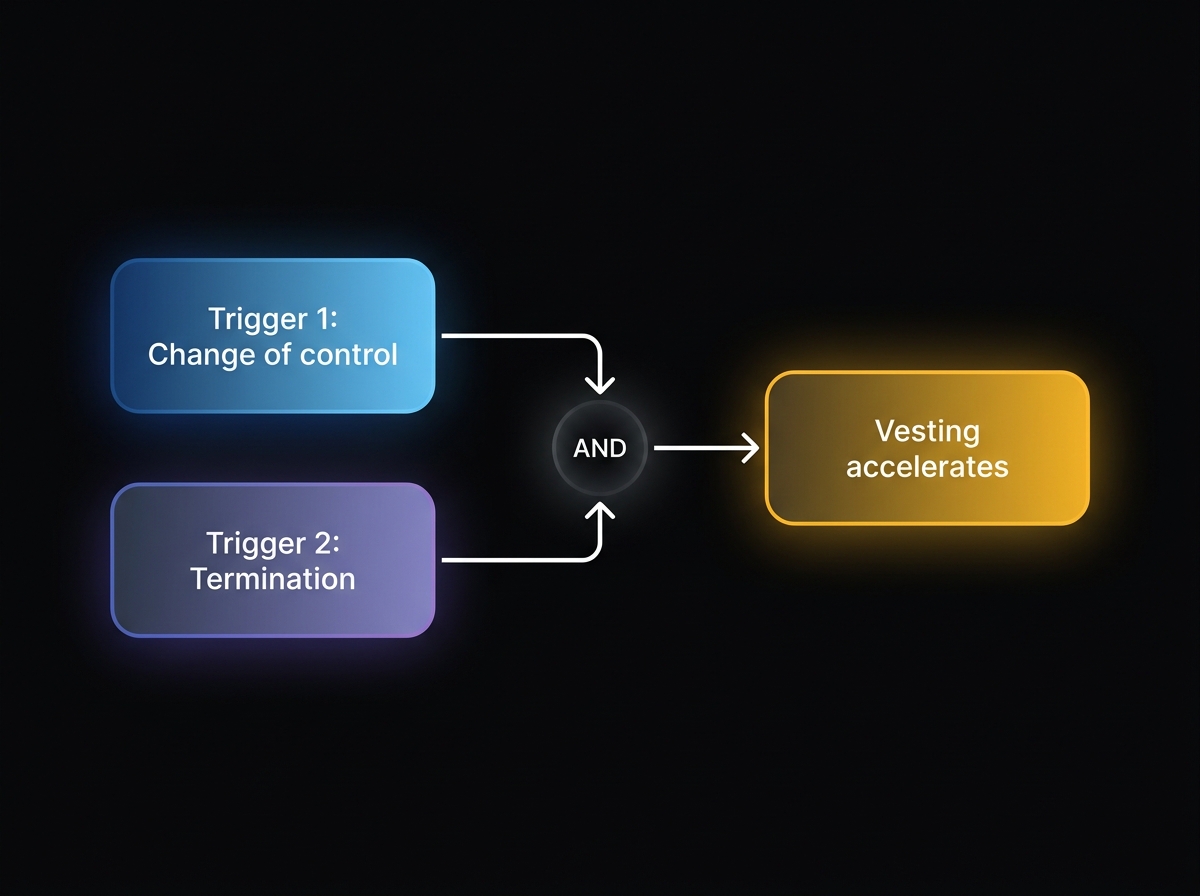
Typical acceleration percentages run 50%-100% of unvested equity. Senior executives negotiate this aggressively in offer letters; junior employees often receive standard plan terms.
Vesting in retirement plans
401(k) plans separate employee deferrals (always 100% vested immediately by federal law) from employer match and profit-sharing (subject to vesting schedules). Two common structures are the three-year cliff (0% until year three, 100% on the anniversary) and six-year graded (20% per year starting in year two). The IRS describes vesting in a retirement plan as ownership: the share of employer contributions you actually own. For someone changing jobs every two years, retirement-plan vesting can quietly cost tens of thousands of dollars over a career.
ESPPs are not really vesting
Employee Stock Purchase Plans do not use traditional vesting. Payroll deductions accumulate over a 6-12 month offering period, then buy stock at a 15% discount off the lower of the start or end price. You own the shares immediately. What ESPPs do have is holding-period rules for qualified disposition tax treatment: hold two years from offering date and one year from purchase date. Sell earlier and the discount becomes ordinary income.
Tax timing across vesting events
The tax consequences of vesting depend entirely on the instrument. Stock options (both ISO and NSO) generate no tax at vesting itself. ISOs may trigger AMT on exercise (the spread is an AMT preference item) and ordinary or capital gains at sale depending on holding period. NSOs trigger ordinary income on the spread at exercise, then capital gains or loss on sale relative to that exercise-date basis.
RSUs are different. They generate ordinary income automatically at vesting, regardless of whether you sell: the FMV on the vesting date is taxable that year, and your cost basis going forward equals that FMV. Restricted stock awards land somewhere in between: ordinary income at vest by default, but an 83(b) election within 30 days of grant can convert future appreciation into capital gains. That cash-flow difference matters for planning. Grants used inside a management incentive plan often blend RSUs and performance shares specifically so executives have a mix of certain (vest-date) and contingent (target-hit) tax events.
For the full ISO playbook including AMT mechanics and qualified-disposition rules, see incentive stock options. For executive equity programs that combine multiple vesting types, see management incentive plans.
This article is general information about vesting, not tax, legal, or financial advice. Vesting terms and tax treatment are fact-specific and set by your individual grant agreement or plan documents; consult your advisor and read your grant or plan before relying on any vesting or exercise decision.
Vesting vs. exercising: they are not the same
A common confusion: vesting gives you the right to exercise stock options. Exercising is the act of paying the strike price to actually own the shares.
- Vesting: automatic, on schedule, costs nothing.
- Exercising: deliberate, costs money (or uses cashless exercise), creates tax events.
Most option plans give you 90 days post-termination to exercise vested options or forfeit them. Some companies extend this window (a few offer multi-year or even full-term post-termination exercise), but the 90-day default remains standard.
For founders modeling outcomes, vesting governs how much equity exists in employee hands, and only vested options are exercisable; the waterfall analysis governs what that equity is worth at exit.
Frequently asked questions
What does “vested” mean in finance or for shares?
In finance, vested means you have earned unconditional ownership of an asset (stock, options, or retirement contributions), so it cannot be taken back even if you leave the company. Unvested means you would still forfeit it on departure. The distinction is timing: vesting converts a conditional grant into property you own outright.
Is being fully vested a good thing?
Yes. Fully vested means you own 100% of the grant or account, with nothing left to forfeit if you leave. Until then, leaving forfeits the unvested portion. There is no downside to being vested; the only trade-off is the time you commit to get there.
What happens to unvested stock if I quit?
You forfeit it. The company reclaims unvested options, RSUs, or restricted stock the day you leave. Already-vested shares are yours regardless.
Can a company take back vested stock?
Almost never. Vested equity is earned compensation. The only exceptions are clawback provisions for fraud, criminal conduct, or major policy violations, and those are rare and heavily lawyered.
Where do I find my vesting schedule?
In your equity grant agreement (signed when you accepted the grant) and on your equity management platform (Carta, Shareworks, E*TRADE, and similar). Both should show your vesting start date, cliff, schedule, and current vested shares.
Does vesting continue after acquisition?
Usually yes, if you remain employed. Acquirers typically assume your existing schedule or convert your equity into theirs at an exchange ratio. Double-trigger acceleration applies only if you are also terminated post-acquisition.
How does vesting affect taxes?
It depends on the instrument. RSUs generate ordinary income on the vesting date FMV. Stock options generate tax at exercise (NSOs) or sale (ISOs). Restricted stock awards can use 83(b) elections to lock in early-stage tax treatment. Plan around vesting cycles, not just calendar years.
The bottom line
Vesting converts a conditional promise into earned ownership: vested equity and benefits are yours to keep, unvested ones are forfeited if you leave, and the four-year, one-year-cliff schedule remains the default for startup grants. The instrument and the schedule together determine how much you own at any moment and how it is taxed.
Vesting governs how much equity is actually in employees’ hands at any point, and only vested options are exercisable, but what that vested equity is worth depends on the exit. Waterfalls models option pools, dilution, and exit-waterfall distributions from a cap table. It does not track or administer your vesting schedule (your equity platform does that), but it shows what vested and unvested grants mean for founders and employees across exit scenarios.